
MikroORM v7.2 is out. The headline is native PostgreSQL row level security — policies as entity metadata, managed by the schema generator, with per-request session context pushed down to the connection. Next to that: a new through option for to-one relations resolved via subquery, a rework of cursor pagination for custom types and nullable sort keys, a new sql.js driver that brought a live playground to the docs, named parameters in em.execute(), string normalization, native client access, await using support, and a handful of smaller things. Let's go through the highlights.

Row level security
Multi-tenancy in an ORM usually comes down to remembering a where tenant_id = ? on every single query. Filters help, but they only cover what goes through the ORM's query pipeline — one raw query, one native update, one forgotten disableFilters and the boundary is gone. PostgreSQL has had row level security for over a decade, and it puts that boundary where it cannot be forgotten: in the database.
v7.2 makes RLS a first-class part of entity metadata. Policies are declared on the entity, created and diffed by the schema generator, introspected back from pg_policies, and serialized into migration snapshots:
- defineEntity
- decorators
export const Article = defineEntity({
  name: 'Article',
  properties: {
    id: p.integer().primary(),
    tenantId: p.uuid(),
  },
  policies: [
    {
      name: 'article_tenant',
      using: columns => `${columns.tenantId} = current_setting('app.tenant')::uuid`,
      check: columns => `${columns.tenantId} = current_setting('app.tenant')::uuid`,
    },
  ],
});
@Entity({
  policies: [
    {
      name: 'article_tenant',
      using: columns => `${columns.tenantId} = current_setting('app.tenant')::uuid`,
      check: columns => `${columns.tenantId} = current_setting('app.tenant')::uuid`,
    },
  ],
})
export class Article {

  @PrimaryKey()
  id!: number;

  @Property({ type: 'uuid' })
  tenantId!: string;

}
alter table "article" enable row level security;
create policy "article_tenant" on "article" using (tenant_id = current_setting('app.tenant')::uuid) with check (tenant_id = current_setting('app.tenant')::uuid);
The using / check expressions accept a callback receiving the property-to-column mapping (typed in all three definition styles, the same shape check constraints already use), a plain SQL string, or a raw() fragment. Prefer the callback — column names come from the naming strategy, and the expression stays correct when a column is renamed. Policies support command (select / insert / update / delete / all), roles, and type: 'permissive' | 'restrictive', so you can widen access with OR-combined permissive policies and pin a mandatory constraint on top with a restrictive one.
rowLevelSecurity: true without policies is a deny-all switch. 'force' applies the policies to the table owner too (without it, owners and superusers bypass RLS entirely). false creates the policies but leaves RLS disabled, which lets you stage them ahead of a cutover and flip the switch later.
Session context
Policies read per-request state through current_setting(...) or current_user, so the ORM needs to get that state onto the connection. It carries it as a session context on the EntityManager — session variables plus an optional role:
const em = orm.em.fork({
  session: {
    variables: { 'app.tenant': tenantId },
    role: 'app_user',
  },
});

const articles = await em.find(Article, {}); // only this tenant's rows come back
There are two strategies for how it reaches the database. The default 'transaction' emits select set_config(key, value, true) and set local role right after each begin, which is safe under pgBouncer transaction pooling. Operations outside an explicit transaction get wrapped in a short implicit one — but only when a session context is actually set, so there is no overhead if you don't use RLS:
begin;
select set_config($1, $2, true);
select ... from "article" ...;
commit;
The 'connection' strategy (postgresql driver only) applies the context on every pool acquire instead, always preceded by reset all, so a pooled connection never carries stale state. It needs session-level pooling, but removes the implicit-transaction wrapping and handles em.stream() without ceremony.
The design is fail-closed throughout. Setting a session context with implicitTransactions: false throws rather than letting writes run untransacted past the policies. Streaming outside a transaction under the 'transaction' strategy throws rather than streaming rows nothing scoped. Neither strategy lets you change the context mid-transaction, since the running transaction would never see it. Write violations surface as RowLevelSecurityViolationException, and the session context is folded into the result cache key, so two tenants issuing the same query never share a cached result.
The filter bridge
If you already model tenancy as an entity filter, you don't have to write the policy twice. Flag the filter with rls: true and the same declaration drives both layers:
filters: {
  byTenant: { name: 'byTenant', cond: args => ({ tenantId: args.tenant }), rls: true },
},
At schema time it compiles to a policy, deriving the session variable name and the SQL cast from the property type:
create policy "order_byTenant_policy" on "order" using ("tenant_id" = current_setting('mikro.byTenant.tenant')::uuid);
At runtime, em.setFilterParams('byTenant', { tenant: tenantId }) stages both the application-level where and the matching session variable:
await em.find(Order, {}, { filters: ['byTenant'] }); // ... where "tenant_id" = ?
await em.execute('select * from "order"');           // still only this tenant's rows
One declaration, two enforcement layers. Conditions that can't compile to a static policy (touching em or find options, async, an argument used outside a direct comparison, a column type with no cast) fail loudly at schema build rather than silently producing a policy that does less than the filter.
This is PostgreSQL only — postgresql and pglite, with pglite limited to the 'transaction' strategy since it has no pool to hook. Other drivers reject RLS metadata at discovery. If your database already has hand-written policies, read the adoption section before running any schema tooling after the upgrade — the schema generator can see them now, and a live-introspection diff will propose dropping them unless you adopt them into metadata or set schemaGenerator: { ignorePolicies: true }. The row level security guide covers the whole thing, including the operational caveats around owner bypass, role grants and pgBouncer modes.
To-one relations through another entity
Not every link to a single related entity is a foreign key on the owning table. Two shapes come up over and over: a pivot entity that carries the link plus extra columns to filter on, and a to-many relation you only want one item out of — typically the newest one. Both are now expressible as a read-only ManyToOne / OneToOne with the new through option:
- defineEntity
- decorators
export const Customer = defineEntity({
  name: 'Customer',
  properties: {
    id: p.integer().primary(),
    edges: () => p.oneToMany(Edge).mappedBy('start'),
    // the account linked via an edge in the `cleared` state
    account: () => p.manyToOne(Account).through(() => Edge).where({ state: 'cleared' }).ref().nullable(),
    // the newest edge of this customer, picked out of the `edges` collection
    latestEdge: () => p.oneToOne(Edge).through(() => Edge).orderBy({ id: 'desc' }).ref().nullable(),
  },
});

export const Edge = defineEntity({
  name: 'Edge',
  properties: {
    id: p.integer().primary(),
    start: () => p.manyToOne(Customer),
    end: () => p.manyToOne(Account),
    state: p.string(),
  },
});
@Entity()
export class Customer {

  @PrimaryKey()
  id!: number;

  @OneToMany(() => Edge, e => e.start)
  edges = new Collection<Edge>(this);

  // the account linked via an edge in the `cleared` state
  @ManyToOne(() => Account, { through: () => Edge, where: { state: 'cleared' }, ref: true, nullable: true })
  account?: Ref<Account>;

  // the newest edge of this customer, picked out of the `edges` collection
  @OneToOne(() => Edge, { through: () => Edge, orderBy: { id: 'desc' }, ref: true, nullable: true })
  latestEdge?: Ref<Edge>;

}
The where and orderBy options apply to the through entity, and the first matching row wins. The ORM resolves the target primary key with a correlated subquery:
select c.*, (
  select e.end_id from edge as e
  where e.start_id = c.id and e.state = 'cleared'
  limit 1
) as account_id from customer as c
When through points at the target entity itself there is no pivot, and the subquery selects that entity's primary key directly — the latestEdge case above. It's the same result as loading the whole edges collection and taking the newest item, without loading the collection.
Under the hood this is the existing non-persistent formula relation, so there are no new code paths: both loading strategies, Loaded<> inference, serialization, mapToPk and conditions on the relation all work as they do for any other to-one. The relation is read-only — no column, no FK constraint, assignments ignored during flush; you write through the through entity. If you need conditions that reach past the through entity's own columns, the docs also cover writing the subquery by hand with formula, which is all through is a shortcut for. See to-one relations through another entity for the full reference.

Cursor pagination, reworked
Cursor-based pagination had two categories of input where it quietly returned the wrong page. Both are fixed in v7.2.
The first is custom types over datetime columns. The decode path healed every string offset through new Date(), which truncates sub-millisecond precision, so boundary rows were silently skipped for Temporal-style wrapper types. Rather than widening the shape heuristics further, the type is now the authority over its own cursor wire format via a new optional Type.fromJSON(), paired with the existing toJSON:
class TemporalInstantType extends Type<Temporal.Instant, string> {

  override toJSON(value: Temporal.Instant) {
    return value.toString();
  }

  override fromJSON(value: unknown) {
    // cursors are client supplied — validate and throw for what you cannot restore
    return Temporal.Instant.from(value as string);
  }

}
Implementing it routes cursor encoding through toJSON and passes the decoded value back to fromJSON; a failure surfaces as a CursorError. DateTimeType and BigIntType ship implementations (the bigint one also fixes encoding — a bigint cursor member used to crash in JSON.stringify). Types without fromJSON keep the previous wire format, and the fallback now tries the type's own string parsing before healing to a Date.
The second is nullable sort keys. Keyset pagination needs the emitted orderBy and the keyset condition to agree on where nulls sit, and they disagreed in three separate ways: the rewritten orderBy dropped the nulls first / nulls last qualifier, desc nulls first was treated as ascending, and a non-null offset compared with $gt never matched a null key, so pagination could not enter the null block at all. Nullable keys now carry an explicit placement, both sides resolve the direction through one parser, and a comparison against a nullable key gets a null arm when the null block lies ahead.
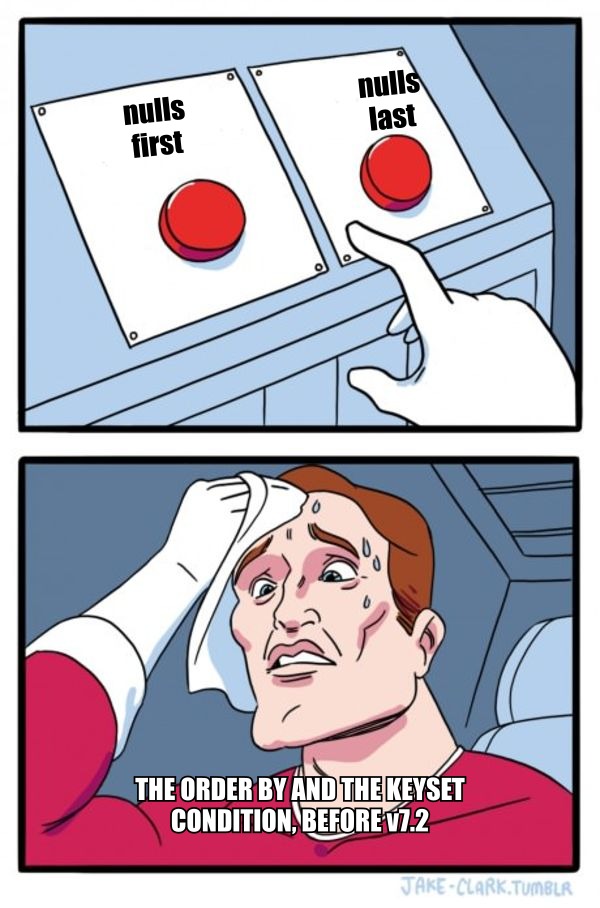
Two new platform hooks back this: supportsNullsOrdering() reports whether the placement can be requested at all (native on PostgreSQL, SQLite and Oracle, emulated on MySQL and MSSQL), and sortsNullsLowest() states what the database does when nobody asks — so an unqualified direction is left alone instead of being rewritten, and findByCursor returns the same order as find for the same orderBy. MongoDB stops being a special case; it's simply a platform that sorts nulls lowest and cannot be told otherwise.
A nested orderBy group is a keyset in its own right, and it now decomposes lexicographically like the top level does — { author: { rating, name } } used to compare its keys independently and AND them together, dropping rows whose first key was past the cursor while the second wasn't. @Formula properties are treated as nullable, since the ORM cannot know otherwise.
Worth knowing when you upgrade: ordering by a nullable key now emits an explicit nulls placement, which adds an order by term on MySQL and MSSQL where the placement is emulated. On MongoDB, pagination over a nullable key changes to follow the nulls-lowest ordering mongo actually produces. Cursor.for payloads changed shape for the inputs it previously mishandled, and payloads produced by older versions still decode.
The sql.js driver, and a playground in the docs
There's a new driver in the family: @mikro-orm/sql-js. It runs sql.js, SQLite compiled to WebAssembly, entirely in memory in the browser, Node.js, Bun and Deno, with no native bindings anywhere. It sits on the shared @mikro-orm/sql base the same way @mikro-orm/libsql does and reuses the SQLite platform, so feature support matches @mikro-orm/sqlite:
import { defineConfig } from '@mikro-orm/sql-js';

export default defineConfig({
  entities: ['./dist/entities'],
  entitiesTs: ['./src/entities'],
});
The database always lives in memory, so dbName defaults to :memory: and there is nothing to point it at. Options under driverOptions are forwarded to initSqlJs() (locateFile, wasmBinary) — bundlers need locateFile to resolve the URL they emit for sql.js/dist/sql-wasm.wasm — with two of the driver's own on top: sqlJs hands over a module you initialised yourself, and data opens an existing SQLite file image instead of an empty database. Paired with getNativeClient(), which returns the sql.js Database, that is how you persist state across sessions:
const db = await orm.em.getConnection().getNativeClient();
const data = db.export(); // Uint8Array, the SQLite file image
Keep in mind the database lives and dies with the connection. orm.close() frees the WASM database, and reconnecting starts from an empty one (or from driverOptions.data), so the schema has to be created again. See usage with sql.js for the setup details.
The driver also powers something more visible. The getting-started guide used to embed StackBlitz; those are gone, replaced by a playground that runs in the page itself — Monaco for editing, sucrase for transpiling, a Web Worker for execution — so the guide's code runs against a real database while you read it. It is wired into checkpoints 1 and 2, with a QueryBuilder companion in chapter 4.
Named parameters in em.execute()
em.execute() and connection.execute() now take a plain object of named parameters as an alternative to the positional array — :name for values, :name: for identifiers:
await em.execute(`
  insert into geo_seed (country, region, city)
  values (:country, :region, :city)
  on conflict (city)
      do update set country = excluded.country,
                    region  = excluded.region
`, { country, region, city });
The same works in the raw() helper, where parameters may repeat:
const fragment = raw('select :col: from geo_seed where city = :city or region = :city', { col: 'city', city: 'Brno' });
This also fixes the named parameter translation in raw() itself, which used to bind values in object-key order rather than SQL-placeholder order, replace only the first occurrence of a repeated token, and corrupt the query when one key was a prefix of another (:city vs :cityCode). It is now a single left-to-right scan that leaves PostgreSQL :: casts and unmatched tokens alone. See named parameters for the details.
String normalization
StringType and TextType can now trim and case values on the way to the database. With defineEntity, there are string-specific builder methods:
const Customer = defineEntity({
  name: 'Customer',
  properties: {
    id: p.integer().primary().autoincrement(),
    currency: p.string().trim().uppercase(),
    email: p.string().trim().lowercase().unique(),
    biography: p.text().trim(),
  },
});
Decorators and EntitySchema configure the mapped type directly:
@Property({ type: new StringType({ trim: true, case: 'upper' }) })
currency!: string;
Normalization runs when values are written to the database or used as ORM query parameters, so the value you search by and the value you stored agree. It is deliberately not a property setter: direct assignment, em.create() and em.assign() keep the assigned value in memory, and the flush writes the normalized form without mutating the property. p.string() with no options keeps the existing fast path, and the type benchmarks show no regression. Existing columns holding non-normalized data want a migration before you enable this. See normalizing string properties.
Accessing the native client
Every driver runs on some vendor client, and until now the only supported handle was getClient(), which returns the Kysely query builder on SQL drivers. For vendor APIs the ORM does not wrap, there's now getNativeClient(), narrowed to each driver's own client type:
const pool = await orm.em.getConnection().getNativeClient(); // `Pool` from `pg`
| Driver | Returns |
|---|---|
postgresql | Pool from pg |
mysql, mariadb | Pool from mysql2 |
sqlite | Database from better-sqlite3 |
libsql | Database from libsql |
pglite | PGlite from @electric-sql/pglite |
oracledb | Pool from oracledb |
mongodb | MongoClient |
The request that prompted this was reaching the PGlite instance to run pgDump at runtime — it lives in a native private field, so there was no way to get at it:
import { pgDump } from '@electric-sql/pglite-tools/pg_dump';

const pglite = await orm.em.getConnection().getNativeClient();
const dump = await pgDump({ pg: pglite });
It throws on mssql, which has no long-lived native client (use the onCreateConnection / onReserveConnection hooks to reach tedious connections), and when you supplied a ready-made Kysely instance or dialect via driverOptions, since the driver never creates a client of its own then. Unless you provided the client yourself, its lifecycle stays with the ORM — leave the closing to orm.close().
await using
The MikroORM instance implements the async disposable protocol, so explicit resource management closes the connection for you:
await using orm = await MikroORM.init(config);
// `orm.close()` is called automatically at the end of the enclosing scope
Symbol.asyncDispose exists at runtime since node 18.18, so this works on node 22 without a polyfill — only the await using syntax itself needs node 24+ or a transpiler (TypeScript downlevels it for any target below ESNext).
Smaller improvements
A few more additions worth mentioning:
indexon M:N properties — whether the generated pivot table's join columns get indexed used to be the platform default with no way to override it, which meant no index at all on PostgreSQL.@ManyToMany({ entity: () => User, index: true })(orp.manyToMany(User).index()) now indexes the join columns not already covered by a leading prefix of the pivot's composite PK (the inverse join column for the default pivot, both withfixedOrder). A string names the index, andindex: falsedisables the platform default — handy on SQLite, which indexes every FK.em.map()can bypass the identity map —em.map(User, row, { disableIdentityMap: true })converts raw database results into an entity without touching the current context. The motivating case is CDC processing, where the before-image should not evict the after-image from the identity map.RequestContext.create()accepts a callback for the options — when you pass an array of entity managers from different ORM instances, the options can now be acontextName => optionsfunction, so each instance gets its own. Useful for e.g. deriving the schema from the request for the default instance while leaving an admin instance on its own.migrations.snapshotOnMigrate— set it tofalseandmigration:up/migration:downstop rewriting the snapshot from database introspection, leaving it managed solely bymigration:create. Teams that generate migrations without a live database and enforce snapshot freshness in CI get a single source of truth for the file; the trade is that the snapshot no longer follows the database after amigration:down. Also available asMIKRO_ORM_MIGRATIONS_SNAPSHOT_ON_MIGRATE.nubCLI TypeScript loader —@nubjs/loaderjoinsoxc,swc,tsx,jitiandtsimpas atsLoaderoption, either via"mikro-orm": { "tsLoader": "nub" }inpackage.jsonorMIKRO_ORM_CLI_TS_LOADER=nub. Automatic detection never picks it, so you opt in explicitly. It reads the projecttsconfig.json, and rejects a custom tsconfig path rather than silently ignoring one.- CLI
-qflag — suppresses informational output on every command (errors still print), which makes the CLI behave when it's called from a larger script or as a JS module, where the output buffer is shared with the caller. cache:generate --combinedtakes a path —--combined="../cache/mikro-orm-metadata.json"writes the bundle where you want it (relative to thetempfolder), instead of only to the default location.
What do you think?
Those were the highlights. There are more improvements and bug fixes throughout — check the full changelog for the complete list, and let us know what you think in the comments!